
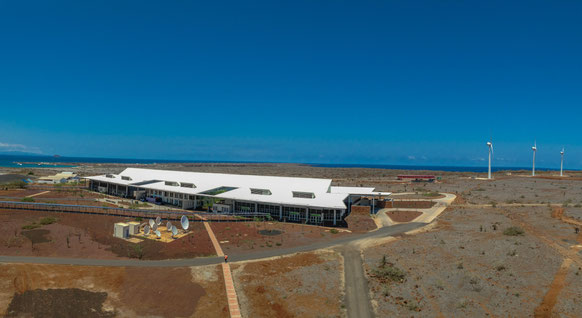
Anyone visiting the Galápagos Islands enters one of the world’s most valuable—and at the same time most fragile—natural environments. The archipelago’s unique wildlife and flora can only be preserved if both access to the islands and the local infrastructure are managed responsibly. The ecological airport on Baltra Island demonstrates how this can be achieved.
Seymour Airport, also known as the Galápagos Ecological Airport, serves as the main gateway to the archipelago for many international visitors. It is located on the small, uninhabited island of Baltra, close to Santa Cruz. From here, travellers continue their journey to the inhabited islands and into the Galápagos National Park. This gives the airport a unique responsibility: it provides access to one of the world’s most extraordinary natural environments while helping to protect it at the same time.
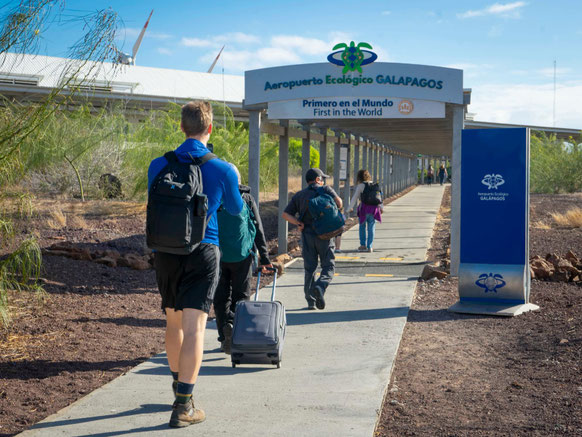
An Airport Designed to Work with Nature
From the very beginning, the airport was planned with the goal of minimising its environmental impact. Both its architecture and daily operations make use of Baltra’s natural conditions. Daylight, prevailing winds and local temperatures were deliberately incorporated into the design. Large skylights provide natural lighting and ventilation, significantly reducing the need for artificial lighting and air conditioning.
Sustainability also played a central role during construction. More than 80 percent of the materials from the former airport were reused. Timber and steel structures were given a second life, while local materials such as volcanic rock allow the building to blend harmoniously into its surroundings. Areas affected by construction were restored and replanted with native vegetation.
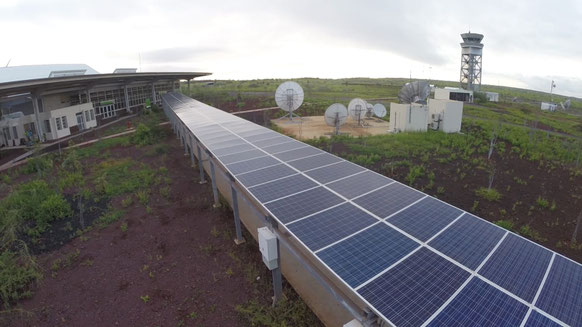
The airport's energy supply is based entirely on renewable sources. Solar panels and wind turbines generate the electricity required to operate the terminal. The concept is complemented by a desalination plant. The freshwater produced is used throughout the building, then treated and recycled. Water-saving systems, including waterless urinals, further reduce both water consumption and wastewater generation.

International Recognition for a Holistic Approach
Baltra Ecological Airport has been awarded LEED Gold certification, an internationally recognised distinction for buildings that meet high standards in energy efficiency, water conservation, material selection and environmental quality. In addition, the airport became the first airport in Latin America and the Caribbean to achieve carbon neutrality certification under Airports Council International’s Airport Carbon Accreditation programme.
These awards are more than prestigious distinctions. They demonstrate that sustainable infrastructure is achievable when environmental objectives are integrated into every stage of planning, construction and operation.
Protecting Nature Requires a Shared Commitment
Baltra Airport clearly demonstrates that nature conservation and tourism do not have to be at odds. However, success depends on every stakeholder assuming responsibility. The Ecuadorian government and the Galápagos National Park have established strict environmental regulations. Developers and airport operators implement these requirements through technical and operational measures. The local community benefits from employment opportunities and a reliable connection to mainland Ecuador. At the same time, visitors can contribute by respecting regulations, using natural resources responsibly and experiencing the islands with care and consideration.
The figures illustrate the importance of this responsibility. During its first fifteen years of operation, Baltra Airport handled approximately 7.5 million passengers. In 2025 alone, more than 527,000 travellers passed through the terminal. With such a high number of visitors, sustainable solutions are essential to ensure that mobility remains possible without exceeding the ecological limits of this exceptionally fragile ecosystem.
For this reason, Baltra Ecological Airport is far more than a transport hub. It is an example of what responsible tourism can look like: providing people with access to one of the world's most remarkable natural environments while ensuring that the infrastructure itself actively contributes to its protection.
This is an important message—not only for the Galápagos Islands, but for sensitive natural regions around the globe.