
A bright red bird, barely larger than a hand – yet it tells an evolutionary story spanning more than a million years. A new genetic study now reveals that the Galápagos Vermilion Flycatcher is not a single, uniform population, but is made up of several island lineages that have been separated for hundreds of thousands of years.
Researchers analyzed the complete genome of 53 birds, including historical museum specimens. The results are striking: at least eight clearly distinct genetic lineages have evolved on different islands.

STUDY RESULTS HAVE CONSEQUENCES FOR NATURE CONSERVATION
The case of Floreana is particularly remarkable. The population there – now extinct – was the most genetically distinct within the species. It had evolved independently for more than 1.2 million years. On Santa Cruz, Isabela, and Santiago as well, separate evolutionary units exist, each with its own unique history.
The study also highlights just how isolated these populations are. Even between nearby islands, there is almost no genetic exchange. Differences in male song, body size, and female plumage further underline this long period of separation.
These findings have far-reaching implications for conservation. When all island populations are grouped under a single species name, dramatic declines of individual lineages can be overlooked. On Santa Cruz, only about 30–40 individuals remain today, with significantly reduced genetic diversity, making the population especially vulnerable.
The researchers therefore propose re-evaluating the taxonomy. Some lineages may in future be recognized as distinct species or subspecies. This would allow their conservation status to be assessed more precisely and protection measures to be planned on an island-specific basis.
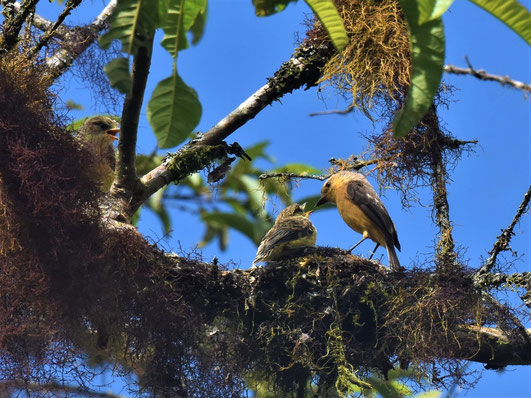
The study powerfully demonstrates how modern genomic research sharpens our understanding of biodiversity. It reminds us that each island carries its own evolutionary history – and that the loss of a small population means the irreversible loss of a unique genetic lineage.
The Galápagos Vermilion Flycatcher is more than a brilliantly colored bird. It is a symbol of how complex, fragile, and fascinating the natural world of the Galápagos Islands truly is – and how important it is to protect it with nuance and determination.