
A major milestone in conservation has been reached in the Galápagos Islands: for the first time in over 150 years, 158 captive-bred giant tortoises have been released on Floreana Island. This landmark moment marks a crucial step in restoring the island’s ecosystem and offers hope for similar projects worldwide.
Giant tortoises play a vital role in their environment. As “ecosystem engineers,” they shape their habitat by breaking up dense vegetation, dispersing seeds, and promoting the growth of new plants. This, in turn, benefits other species such as birds and iguanas—an essential aspect of what is known as “rewilding.”

Extinct, yet returned
The original Floreana giant tortoise (Chelonoidis niger) was declared extinct in the 19th century, mainly due to overexploitation and the introduction of invasive species that destroyed habitats and preyed on eggs and hatchlings. However, a surprising discovery in 2008 brought new hope: tortoises with Floreana ancestry were found on Isabela Island. These individuals became the foundation of a successful breeding program that has already produced more than 600 tortoises.
The recent release is part of a long-term, science-based restoration plan running through at least 2030. In total, twelve missing species are expected to be reintroduced to Floreana. The project is being carried out by a coalition of organizations and authorities, supported by international partners.
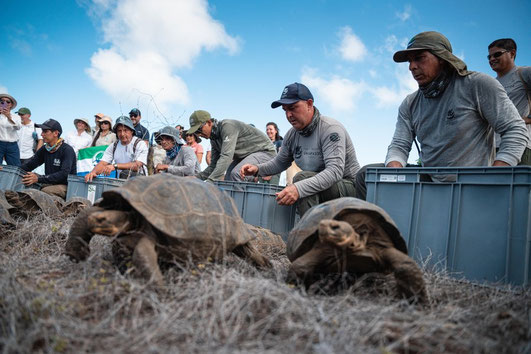
The return of the tortoises was made possible by the successful eradication of invasive species in 2023. Positive impacts are already visible: native bird populations are recovering, a rail species thought extinct for 190 years has been rediscovered, and other native animals are increasing significantly. Local communities are also benefiting, as reduced crop losses have improved food security and household incomes.
The return of the giant tortoises is not only an ecological success but also a powerful signal for the future of conservation in the Galápagos Islands.