
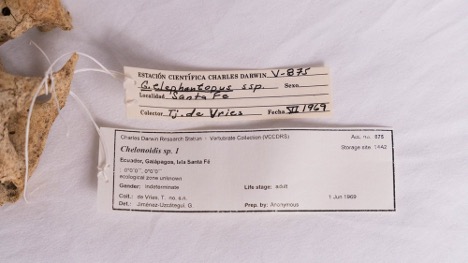
In 1969, after weeks of relentless rain on Santa Fe Island, erosion carved deep channels into the soil and exposed a remarkable find. While out observing hawks, Tjitte de Vries — the first resident scientist of the Charles Darwin Research Station — noticed a small, perfectly preserved tortoise skull among the washed-out gravel. He carefully brought it back to the station, where he and then-director Roger Perry realized it might belong to the long-extinct giant tortoise of Santa Fe.
Historical records and skeletal remains collected during the 1905–1906 expedition of the California Academy of Sciences confirm that an endemic giant tortoise once lived on Santa Fe. However, until that rainy day in 1969, no skull had ever been found. DNA analyses later showed that the Santa Fe tortoise was genetically distinct from tortoises on other islands. The species likely disappeared in the late 19th century, when whalers took live tortoises aboard ships as a food source during long voyages.
hope for a Sensation
Today, the skull is safeguarded in the Natural History Collections of the Charles Darwin Foundation. Scientists are now conducting isotope tests to determine its age. Because nuclear weapons testing in the mid-20th century left detectable radioactive traces in all living organisms, the absence of these isotopes would confirm that the skull predates that era — and truly belongs to the original Santa Fe species.
If verified, this specimen would be the most complete remains ever found of the extinct Santa Fe giant tortoise. Beyond rewriting an important chapter of Galápagos history, it could provide crucial information for formally describing the species and deepening our understanding of giant tortoise evolution.
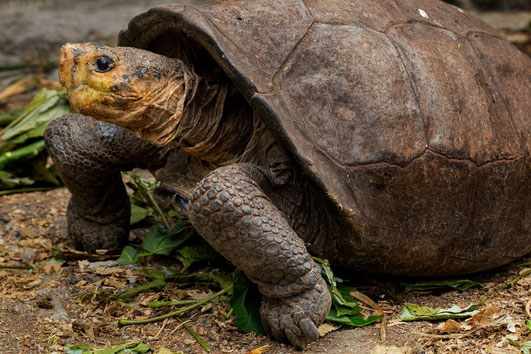
If verified, this specimen would be the most complete remains ever found of the extinct Santa Fe giant tortoise. Beyond rewriting an important chapter of Galápagos history, it could provide crucial information for formally describing the species and deepening our understanding of giant tortoise evolution.
This discovery reminds us how fragile island ecosystems are — and how scientific research continues to uncover lost stories that strengthen conservation efforts for the future.