
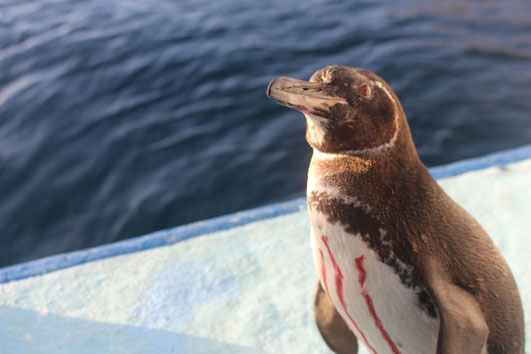
They are undoubtedly the most exotic representatives of their species. Only half a meter tall and weighing just 2 kilograms, Galápagos penguins are the only ones that live north of the equator. They serve as important ambassadors within the local ecosystem, which is why monitoring them is of central importance. However, this is not so easy.
In order to protect an area, a solid database is required, among other things, on the basis of which threats can be identified. Researchers are therefore quickly faced with the question of which individuals are suitable for evaluation. In the Galapagos archipelago, this role is played by penguins, of which there are estimated to be only between 2,000 and 3,000 left. Their small numbers and, above all, their vulnerability to change make them the ideal reference.
Technological aids improve study results
Usually, small chips are implanted under the skin of penguins to identify them and track their movements. However, as this involves physical intervention, photo identification is also used to monitor the population. Software scans the unique spot patterns on the animals' bellies, which significantly reduces stress levels compared to implanting a chip.
However, the results of technological aids are often inaccurate, especially when there is a period of more than a year between the first and second recordings. Within the same year, however, and with the help of additional information regarding gender and colony, the hit rate increases to up to 82%. This type of monitoring is therefore used as a supplementary method to record the health of penguins.

This provides insight into many aspects of the state of the environment. For example, a decline in nesting sites indicates that invasive species that plunder the nests are spreading more widely. There is also a similar correlation between the number of young animals and the integrity of cool lava caves, which are crucial for breeding success.
Galapagos penguins are therefore considered a bioindicator, which is why their protection is essential for research and assessing the condition of the entire archipelago. Help us continue to protect these animals.
Alexander Hornstein