
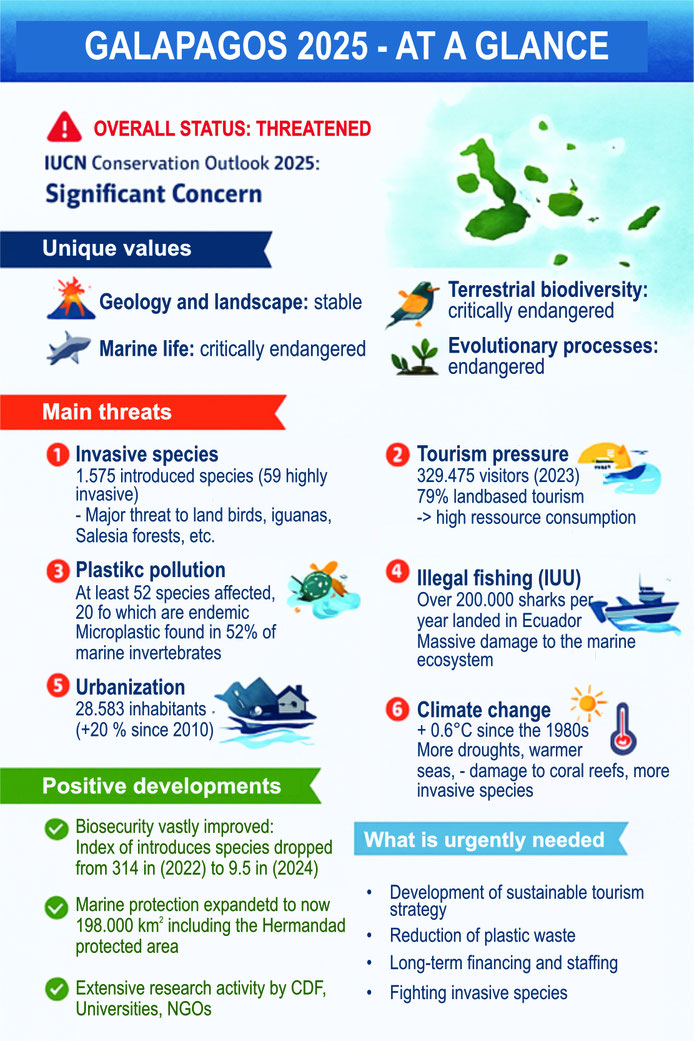
The Galápagos Islands have long captivated scientists, conservationists, and travelers for their exceptional wildlife, striking natural landscapes, and rich evolutionary history. Recognized as one of the earliest UNESCO World Heritage Sites and one of the world’s most iconic Biosphere Reserves, the archipelago continues to draw visitors eager to experience the ecological wonders first observed by Charles Darwin over 150 years ago. However, the rising popularity of the islands has brought complex challenges. The rapid increase of tourism, alongside population growth and expanding economic development, has not always resulted in mutually beneficial outcomes for people and nature. Rather, these pressures have shaped a dynamic and often conflicted socio-ecological system, where human-environment interactions involve tensions between development and conservation goals.
Rising tourist numbers
Today, tourism in the Galápagos has reportedly increased by 260% over the past twenty years, significantly influencing the islands’ political, economic, and ecological landscapes. As the main driver of change in the region, tourism affects both the livelihoods of local residents and the wellbeing of wildlife. Unfortunately, many species have suffered from the pressures associated with this growth. One notable example is the endangered Galápagos sea lion (Zalophus wollebaeki). Research shows that sea lion behavior differs substantially between highly disturbed and minimally disturbed sites. Individuals in more disturbed beaches were observed to be more accustomed to human interactions, with smaller groups showing decreased aggression towards humans. This ultimately underscores the need to limit human-seal interactions and ensure the availability of undisturbed resting areas.

Different interests
In addition to this, human-wildlife conflict is also evident in the agricultural sector, particularly where farmlands overlap with the habitats of Galápagos giant tortoises (Chelonoidis spp.). Predictive mapping revealed that roughly 29% of suitable habitat for the western Santa Cruz tortoise (C. porteri) lies within active agricultural zones. Farmers, faced with damage to crops from tortoises following migration routes now bisected by development, often install unregulated physical barriers as a protective measure. These responses not only hinder tortoise movement but further increase conflict. Agriculture has additionally facilitated the spread of invasive plant species, posing risks to native flora and altering ecosystem dynamics. Such challenges highlight the need to re-evaluate land-use planning, strengthen conservation zoning, and improve invasive species management in order to support both biodiversity and local livelihoods.
Along with wildlife, local communities, too, sit at the center of these socio-ecological complexities. Shifts in governance, from local control to foreign organizations and eventually the Ecuadorian government, have shaped public services and policy priorities in the islands. With conservation and tourism development being prioritized, local needs and services have often been sidelined. As a result, local communities have experienced inequalities and changes to their traditions, sparking resistance and non-compliance to set policies.

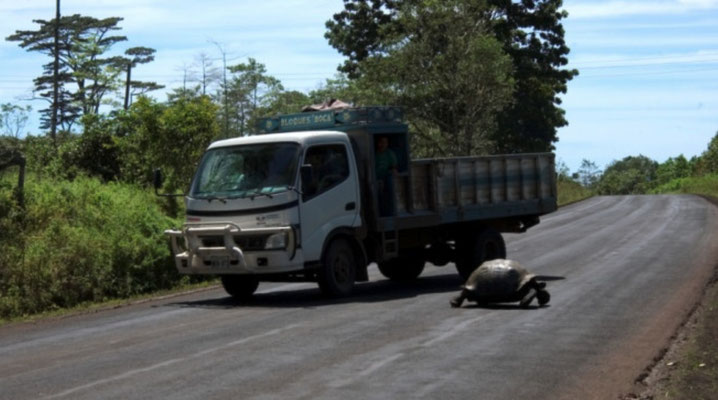
The migration of the tortoises is hindered by fences. Tortoise crosses busy road - Photos: Kamran Safi
Major challenges
All in all, the Galápagos Islands face growing pressures as tourism and development continue to expand, affecting wildlife behavior, ecological integrity, and community wellbeing. Addressing these challenges would require multi-sector cooperation, with thoughtful and adaptive policymaking grounded in scientific evidence, together with local participation. Strengthening protection for wildlife, regulating tourism intensity, improving agricultural land-use planning, and ensuring inclusive governance will be essential for reducing conflict and supporting long-term sustainability.
By integrating conservation priorities with community needs, the Galápagos can continue to serve as a global model for biodiversity protection and responsible development.
Theadora Elizabeth C. Laorenza