
It is 6 a.m. and the garua fog hangs over the port of Puerto Ayora, where I am waiting for researcher David Anchundia from the Charles Darwin Station's (CDF) land bird team. With a broad smile, he gets out of the car and introduces me to the others. Miriam San José is part of Heinke Jäger's team and is involved in removing invasive species to renature the Scalesia forests. We are also accompanied by an entomologist from the CDF and a journalist who is writing an article about the Little Vermillion Flycatcher (Pyrocephalus nanus).
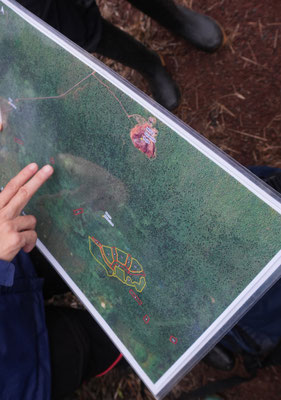

Miriam explains the distribution of renaturation areas and the development of Scalesia forests between 1915 and 2017
IMPRESSIVE NATURE
We drive across the island, past various farms, directly into the highlands to Mina de Granillo Rojo. We stop at a mudslide and David explains that this used to be a paved road, but it was softened and washed away by a storm some time ago. This is where our ascent begins.
After a 30-minute hike over rough and smooth, we turn onto a barely discernible path and Miriam repeatedly shows us invasive guava, cedar, and cinchona trees. They stretch like a large umbrella over the entire area. The garua mist catches on the leaves of the trees and drips like rain onto the ground, which is very damp and muddy here. We make our way quickly through the dense undergrowth and have to keep dodging blackberry vines that overgrow the path.
A MAJOR EFFORT
Then, abruptly, the thicket ends and we find ourselves in a clearing. Tall scalesia trees grow here and the ground is covered with low grasses and plants. Around this clearing lie felled trees, stacked up to form a wall. The wood provides a home for many insects, which form the food source for the Little Vermillion Flycatchers. At first, we only hear the song of the black-red and yellow-gray Little Vermillion Flycatchers, and suddenly they are there. The curious little birds sit on the branches in front of us and examine us with interest. David's eyes shine as he shows us the young males, whose feathers are beginning to take on their typical red color.
Every 3–4 weeks, the researchers have to remove regrowing blackberries so that the ground vegetation can develop freely and the Little Vermillion Flycatchers can hunt for insects between the scalesia trees. Now I discover lots of dispensers containing feathers, cotton, and flax treated with bird-friendly insecticide, stretched between the scalesia trees. The researchers replace the dispensers every 2 weeks, and even 2–3 times a week during the breeding season from December to March. In this way, the Little Vermillion Flycatchers and Darwin's finches themselves protect their chicks from the deadly bird vampire fly Philornis downsi. It's a wonderful example of nature and species conservation working together.
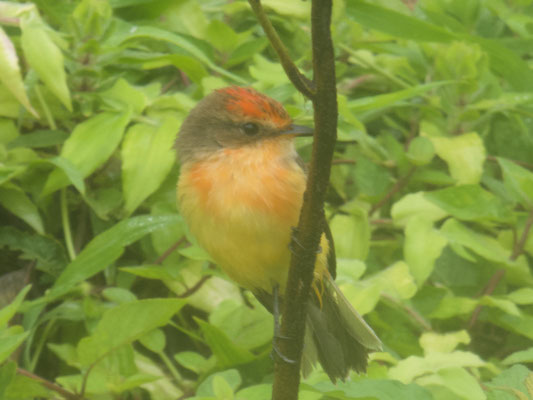
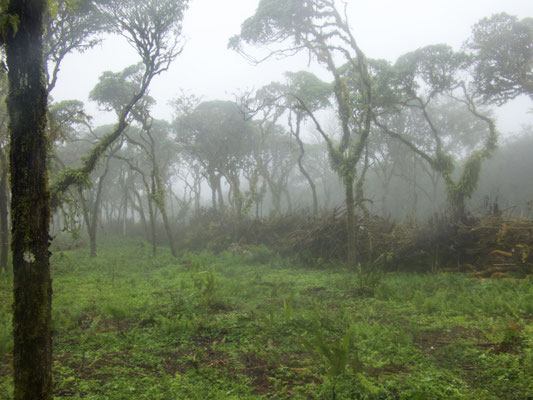
Young male Vermillion Flycatcher changing to adult plumage. Renatured Scalesia forest - Photos: C. Haas
progress
We visit a total of four of these scalesia forest fields in an area covering around 6 hectares. Renaturation began here in 2018. Last year, the researchers were able to start working on another area of around 7 hectares. The original plan was to renature the entire area at Mina de Granilla Rojo within a year. However, the teams realized that this work is very time-consuming, labor-intensive, and requires a lot of personnel. In particular, since the cleared areas have to be reworked again and again, the work is progressing much more slowly than desired and planned.
Deep impressions
On our way back, we encounter a tortoise that was brought here by the national park rangers after recovering from a traffic accident. David explains to us that it would be very important for the renaturalized areas if the tortoises migrated there. This is because these animals play a significant role in keeping the ground clear and allowing the scalesia to grow undisturbed. For this reason, a team of researchers from the Charles Darwin Station is working with farmers to create safe migration routes to the renaturalized areas and make them attractive to the tortoises.
This excursion impressively shows me how important long-term commitment is – and what can be achieved through joint action.
Claudia Haas


Tortoise we encountered on the way back. On this side can you see the accident damage - Photos: C. Haas
You too have the opportunity to support this multifaceted project and help preserve the Scalesia forests, which are unique to the Galápagos, and provide new refuges for the Litte Vermillion Flycatchers. Help us protect this unique ecosystem!